

The film reveals what’s possible when families can access supportive policies. Olympic champion Allyson Felix understands this issue intimately.
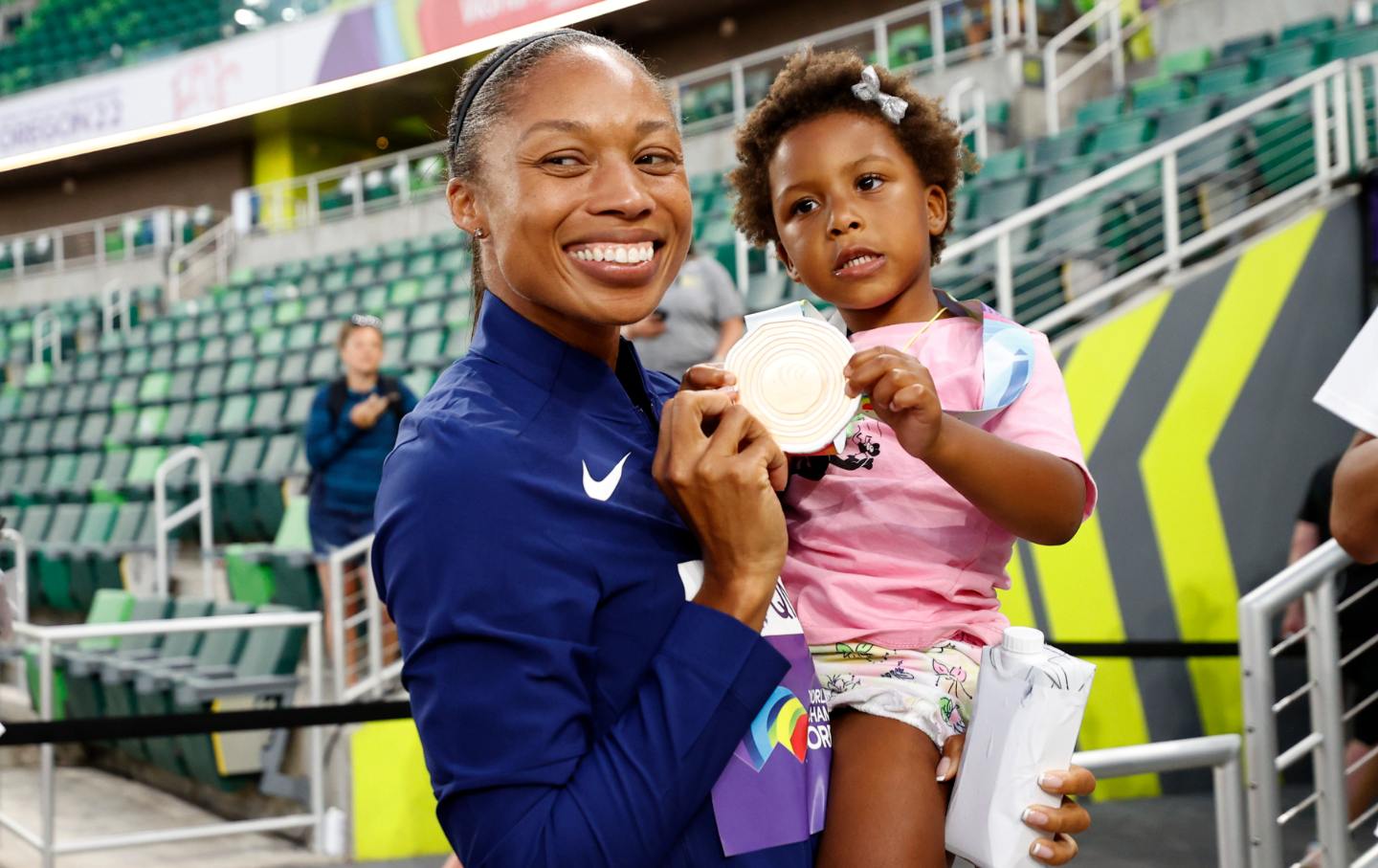
Track and field star Allyson Felix with her daughter, Camryn, at the 2022 World Athletics Championships in Eugene, Oregon.
(Steph Chambers / Getty Images)
Allyson Felix still remembers the beeping of the monitors in the NICU as her daughter was fighting for her life after her preterm birth in 2018. After developing severe preeclampsia, Felix had an emergency C-section and delivered her daughter at 32 weeks. But even in that critical moment, her daughter’s survival wasn’t the only thing on her mind. Years later, speaking on a panel after the premiere of the short film Lifelines in early May, “I was reminded…what that feels like,” she said, “and then thinking about work.”
“It’s this time when you see your child fighting, and yet here you are thinking about your livelihood, and it’s such a horrible place to be,” said the Olympic champion, who co–executive produced the film. “Until people can really understand what that feels like, what that looks like, we have to continue to raise awareness because [paid leave] is something that everybody should absolutely have.” Running at just under 10 minutes, the short documentary shows how state paid leave programs can give families financial stability and a little breathing room when they need it most.
Standing in the hallway of The Annex in Brooklyn, Felix explained to me that she joined the nonprofit organization Paid Leave for All in co–executive producing Lifelines after her eyes were opened to these issues and the way “that so many families don’t get paid leave, have to be thrust immediately back into their responsibilities and work, and just the effect and impact that has.”
Felix, the most decorated female track-and-field Olympian athlete in history, wrote about her ordeal in a New York Times opinion article in 2019, explaining that “she felt pressure to return to form as soon as possible” after giving birth. Around the time of her daughter’s birth, Felix was negotiating her renewal contract with Nike, and the company wanted to pay her 70 percent less than it had in her previous contract. “If that’s what they think I’m worth now, I accept that,” Felix wrote. But she wanted Nike to agree that she would not lose pay if her performance suffered in the period during which she was recovering from her emergency C-section. “Nike declined,” she wrote, and when she went public with her Times op-ed they were at a standstill.
After facing public pressure and questioning from members of Congress about the experiences of its sponsored athletes, Nike eventually updated its policy to create protections for pregnant and postpartum athletes. It is because of Felix, who ultimately separated from Nike and signed a deal with Athleta, and her fellow former Nike-endorsed athletes Alysia Montaño and Kara Goucher that the new paid leave policy became possible.
Felix was not alone. Just one in four working people have access to paid family leave through their job. With the fight for a federal policy effectively at a standstill during the current Congress, advocates are pushing a 50-state strategy, advancing progressive policies and winning at the state level. Earlier this year, Virginia adopted a new paid family and medical leave program, slated to take effect in 2028, guaranteeing workers up to 12 weeks of paid family leave. The program makes Virginia the first Southern state to pass such a policy.
Current Issue

Felix said that she believes that “when people see these stories [in the documentary], it will affect them in a new way and they’ll have a deeper understanding” of the need for paid leave.
The documentary follows two families whose lives are transformed by paid leave: in New Jersey, Habibah and Rasheed, who faced a life-threatening medical emergency three weeks after Habibah gave birth to their third child; and in Colorado, Lee and Elizabeth, who gave birth at 33 weeks and feared running out of leave by the time their new baby finally came home. Both families were able to receive additional time to care for their children through their respective state programs. “[Lifelines] shows us what is possible when we have supports and policies, like paid family and medical leave, that much of the world takes for granted,” said Dawn Huckelbridge, the founding director of Paid Leave for All.
Huckelbridge told me that while the United States is the only country among its peers without a federal paid family leave policy, Paid Leave for All has tracked wins of various kinds in more than 40 states across the country, as well as more incremental positive changes at municipal levels. “Progress is continuing, particularly at the state and local level, where we are seeing strong leadership, but a federal opportunity could be around the corner,” said Huckelbridge. “It’s important that we keep trying to help people’s lives every day that we can with this state-level work, and that we also engage the advocates and the legislators at the state level in helping to push for a federal guarantee.”
Felix took significant personal risks to become an advocate on this issue. She spoke out about the injustices she and other sponsored athletes were facing while she was negotiating with their sponsor. Asked what motivates her to speak out, she said: “It’s just really thinking about others and…realizing that it’s going to take us all coming together to turn things around.”
“I really shied away from [doing things that are difficult] earlier in my career and stayed more in the safe zone,” Felix said. “And then you do one of the things and you’re like, OK. It doesn’t have to always feel good or you don’t have to always feel ready, but it’s important to try to push for change. You’ve got to put yourself out there.”
In late April, the 40-year-old Olympic champion put herself out there in a big way once again, announcing that she is planning to return to running, with the goal of competing in the 2028 Los Angeles Olympics. Initially, she planned to train without drawing a lot of attention to it. “But I was talking to my brother about it and he’s like, I think if you’re vulnerable and share [your experience], you’d be surprised how many others, especially women, are in this place where they’re 40 and not just doing what’s expected and what the world tells us [we’re supposed to do].” She has since gone public about her comeback and her goal of being the first American sprinter to make the Olympics in her 40s if she succeeds. But succeeding isn’t necessarily the goal.
I asked Felix what she hopes her daughter will take away from the experience of watching her mom publicly document this experience. She told me, “I hope that she sees—we’ve even had some conversations already, at her level—you can try. It’s not always about winning, it’s not always about the outcome, but it’s really important to try things. And you don’t know how it’s going to end, and it can be scary. It can be hard. But it’s important to go for things that you want.”