

Politics
/
Authoritarian Watch
/
April 24, 2026
The Trump brand is tarnished, and his grip over the GOP is loosening—but his authoritarian ambitions have not yet been corralled.
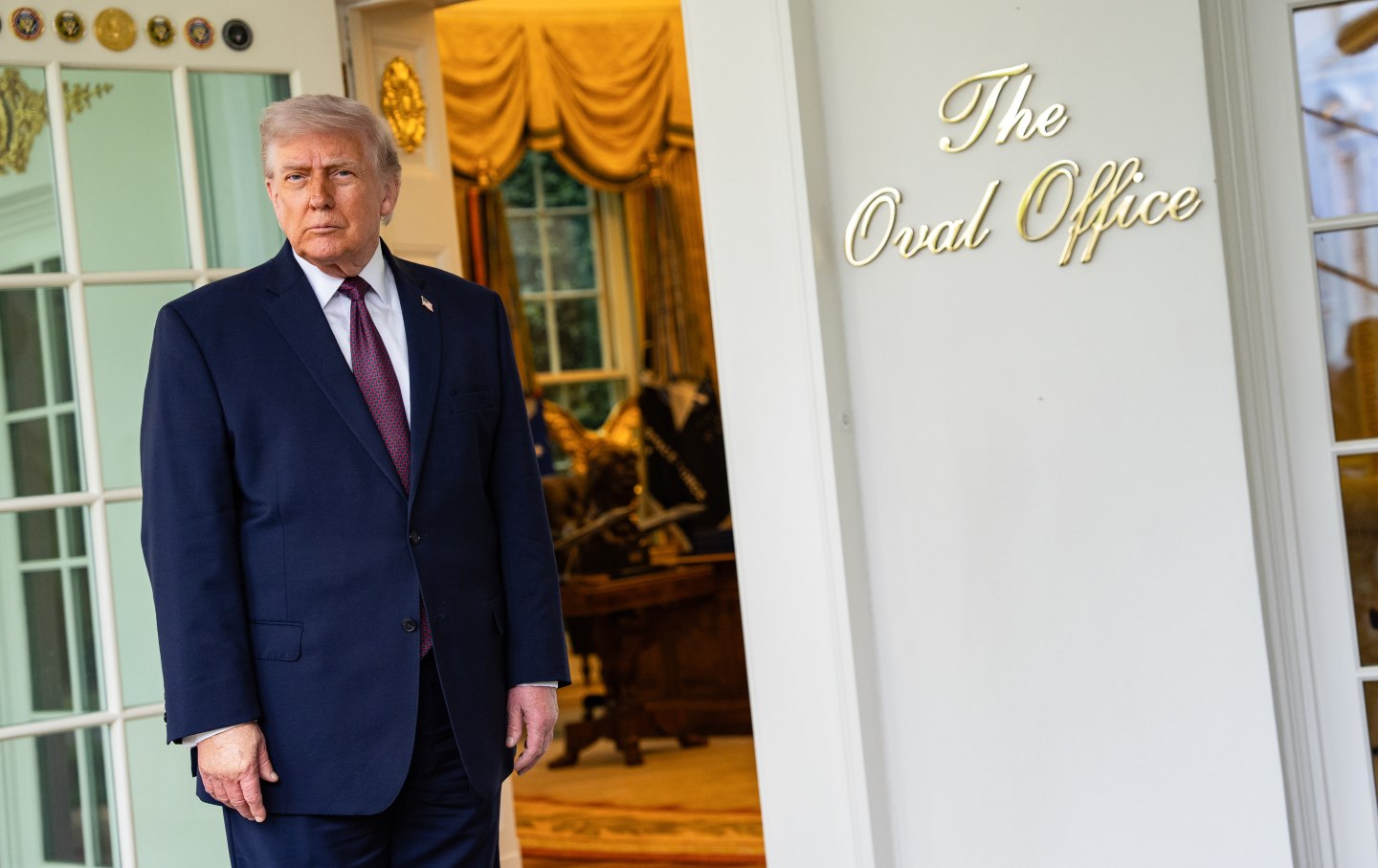
President Donald Trump speaks to members of the media outside the Oval Office of the White House in Washington, DC, on April 13, 2026.
(Salwan Georges / Bloomberg via Getty Images)
For most of Donald Trump’s first presidency and at the start of his second, the MAGA leader’s approval rating hovered in the low 40s—not good but hardly calamitous in an era of perennial discontent with the political classes.
But something has happened in recent months. In poll after poll, Trump’s favorability rating is dipping into the mid-to-low 30s, and on issue after issue, from cost of living to immigration policy, from the ill-thought-out war with Iran to the broader state of the economy, Trump’s signature policies are underwater and getting more so with each successive poll.
Put simply, Trump has overdrawn his political capital by attempting to construct an authoritarian Fortress America. He has turned ICE into a rogue, almost paramilitary, agency but at the cost of his political credibility. He has gone on an imperial real estate spree, talking about or attempting to seize resources from Venezuela and Iran or even the entirety of Greenland and the Panama Canal, but at the cost of fractured alliances and growing anger stateside. He has been drawn into military adventurism overseas but at the cost of increasing disillusionment within his own base. He has shredded decades of investment in and research into renewal energy in an effort to boost the fossil fuel industry—only to run into the political backlash accompanying soaring oil prices that followed the closing of the Strait of Hormuz.
Strongman leaders don’t necessarily need the stamp of public approval to warp the political system in their image. But they do need to maintain their grip on key constituencies to divide and rule a populace. And what we are starting to see is an unraveling of the coalition that Trump used to secure and consolidate his power over the GOP, and by extension the US political and media landscape, for much of the last decade.
Astoundingly, much of the MAGA base now considers Trump a loser—not because of his extremism and irrationality but because he isn’t seen as extreme enough. As detailed in a startling New Yorker article by Antonia Hitchens, a growing number of young men are ditching Trump in favor of the neo-Nazi, misogynistic, and white nationalist politics of Nick Fuentes and his Groyper movement. At the same time, influential conspiracist commentators such as Candace Owens and Tucker Carlson are throwing Trump’s own penchant for conspiracy thinking back into his face—accusing him of being at the center of many of the same alleged conspiracies that he has long accused his political rivals of being a part of. The Epstein files are, if anything, looming larger in the public imagination today than they were at the height of the congressional battle around releasing them.
Evangelicals were astounded by Trump’s recent social media posting in which he distributed an image of himself as a Jesus figure. Conservative Catholics have been appalled by the needless running fight that he has picked with the pope.
Current Issue

And in Congress, a growing number of GOP figures are taking steps—albeit baby-sized ones—away from Trump. They understand that Trump’s ability to impose retribution on them is weakening, and, consequently, they are starting to ignore some of Trump’s diktats. Take Iran: Republicans in Congress may have repeatedly blocked the Democrats’ war powers resolutions that would have reined in Trump’s ability to wage an unconstitutional war, but many are no longer jumping to defend Trump’s handling of the conflict. They have chosen silence, the path of least resistance. In truth, most are simply hoping the problem will disappear.
For Republican politicians, this is a matter of self-preservation: As Trump sinks and as his politics become more toxic to independent voters in swing states such as North Carolina, GOP figures up for reelection are starting to distance themselves from the White House in ways both small and large. Trump’s efforts to strong-arm Congress into passing the voter suppression SAVE Act seem to have gone nowhere; his attempts to secure a speedy funding of the DHS have floundered. Legislatively, Trump is striking out more often than not these days.
There are, I believe, parallels to other revolutionary moments. During the French Revolution, Robespierre took that revolution caroming off in increasingly extreme and irrational directions. And while he was at the height of his powers, ruling largely by executive order, his political allies dared not cross him; indeed, they feigned undying loyalty and staged extraordinary, public shows of sycophancy. Behind the scenes, however, many of those same sycophants could see just how dangerous, unhinged, even messianic Robespierre had become. While swearing loyalty in public, they conspired in private. When the end came, the Thermidorian Reaction, as it became known, was swift: Robespierre was denounced in the parliamentary chambers by his erstwhile allies and a warrant for his arrest was issued. Knowing that he was facing the guillotine, the Jacobin leader tried to kill himself—botching the suicide attempt and shooting off his lower jaw. Shortly afterward, he was dispatched by the same instrument of terror he had used so mercilessly against his opponents.
By and large, when it comes to domestic politics, we live in marginally gentler times than did Robespierre. Trump’s allies aren’t about to finish one of their disgracefully deferential cabinet meetings by literally lopping off his head, but they are clearly jockeying for position in a post-Trump world.
It wasn’t all that long ago that Steve Bannon was telling anyone who would listen that there was a plan for Trump to secure a third presidential term—that this was an inevitability that the country should just suck up and accept. You’re not hearing Bannon—or anyone else for that matter—tout such a scenario anymore.
And as the Iran war debacle becomes political poison, most of the key players have performed vanishing acts. Secretary of State Marco Rubio hasn’t exactly been a visible presence whooping up support for the war recently. National security adviser Tulsi Gabbard—never a fan of overseas interventions to begin with—hasn’t gone out of her way to explain to the American public the war’s rationales. Vice President JD Vance, who also never wanted the war, has been half-heartedly engaging in peace talks with the Iranians, but he hasn’t really gone to bat for Trump’s conflict of choice these past six weeks. When he’s not hopping a plane to Pakistan to deliver Trump’s incoherent, ever shifting demands to the Iranian negotiators, he’s stateside trying to salvage his own, crumbling political ambitions. Sure, Pete Hegseth is continuing to beat the tom-toms of war, but Hegseth is the fool’s fool, a man who has never had his own power base and who will stick with Trump even if Trump asks him to walk through a nuclear hell.
None of which is to say that Trump’s authoritarian aspirations have been corralled. The man remains a menace, and his manifest lunacy only compounds the dangers. But Trump has, these past months, inflicted such harm on his own political brand that it’s increasingly likely he is irreparably damaged. And so as the MAGA train derails, the question increasingly becomes which of Trump’s band of mendacious, self-dealing sycophants will eventually be the one to launch the Thermidorian Reaction.
From illegal war on Iran to an inhumane fuel blockade of Cuba, from AI weapons to crypto corruption, this is a time of staggering chaos, cruelty, and violence.
Unlike other publications that parrot the views of authoritarians, billionaires, and corporations, The Nation publishes stories that hold the powerful to account and center the communities too often denied a voice in the national media—stories like the one you’ve just read.
Each day, our journalism cuts through lies and distortions, contextualizes the developments reshaping politics around the globe, and advances progressive ideas that oxygenate our movements and instigate change in the halls of power.
This independent journalism is only possible with the support of our readers. If you want to see more urgent coverage like this, please donate to The Nation today.