


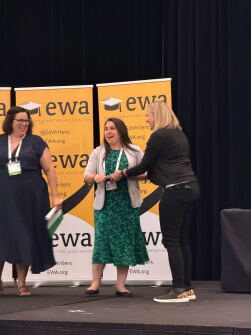
Education Week Assistant Editor Alyson Klein and the media organization’s visuals team won an award from the Education Writers Association this week for a series of stories that probed the politically fraught process pairing neighboring schools, reconstituting them into grade span centers with more racially and economically integrated student bodies.
The enterprise reporting package, published in July 2025, won the EWA award for explanatory reporting in the education outlet division. EWA is a membership organization supporting education journalists nationwide.
Klein reported from Caldwell Parish, a rural, politically conservative Louisiana district that merged an elementary school with dwindling enrollment with its overcrowded neighbors, creating K-1, 2-3, and 4-5 campuses. As a result, the schools saw increased integration, fewer behavior problems, and positive effects on student achievement and engagement.
“The stories illustrate Alyson Klein’s deep expertise in reporting on K-12 schools’ policies, practices, and—especially in this case—politics,” Education Week Editor-in-Chief Beth Frerking said.
“She excels at reporting from the field and is particularly adept at drawing people out to discuss even the most sensitive topics. Combined with riveting photography by freelancer L. Kasimu Harris and engaging illustrations and graphics by our talented visuals team, the project adroitly documents and explores the complicated journey this Louisiana community undertook to combine these two schools.”
Klein contrasted the Louisiana district’s efforts with conversations in the politically progressive city of Washington, where plans to merge a high-performing elementary school in a gentrifying neighborhood with an academically struggling school three blocks away stirred up opposition, division, and distrust.
“Twenty minutes into a phone call with Caldwell’s superintendent, the iron-spined Nicki McCann, I realized I wasn’t just dealing with a story about the differences between a tight-knit rural community and a gentrified urban one, or even just a story about why equity matters,” Klein said. “D.C.’s stumbles and Caldwell’s success came down to leadership—what it takes to get a community to buy into a big, uncomfortable change. That’s a story every district leader in our audience can relate to.”
EWA contest judges praised Klein’s deep reporting.
“It was brilliant, no pun intended, to pair a success story from the rural South with the failure in the ostensibly more enlightened and far more liberal District of Columbia,” a judge wrote.
Klein said she’s grateful to EWA for honoring Education Week’s work, but she was also gratified to get a text from McCann after the stories first published, informing her that the superintendent had been invited to speak to aspiring district leaders about how to make major changes in the name of equity.
“I love that I got to help more educators learn from her and her incredible team,” Klein said.
Education Week has also previously been recognized by EWA for coverage of civics education; the impact of Flint, Mich.’s lead-tainted water on special education; Indian education; and online charter schools’ low performance.
Earlier this year, EdWeek also won recognition from the American Society of Business Publication Editors. The publication received a gold award in the category of magazine of the year, with 11 or fewer issues. In addition, its State of Teaching reporting and research effort was a finalist for project of the year.